
UGC ads
How to make UGC ads with AI (2026 playbook)
UGC-style ads are creator-feeling, phone-shot, talk-to-camera creative. To make them with AI: write one sharp hook, generate a presenter reading a script in your buyer's actual dialect, cut to 3-10 seconds vertical, and produce 3-5 variants per ad group. Then label the AI and never present a synthetic actor as a real customer — the FTC rule on fabricated testimonials is explicit.
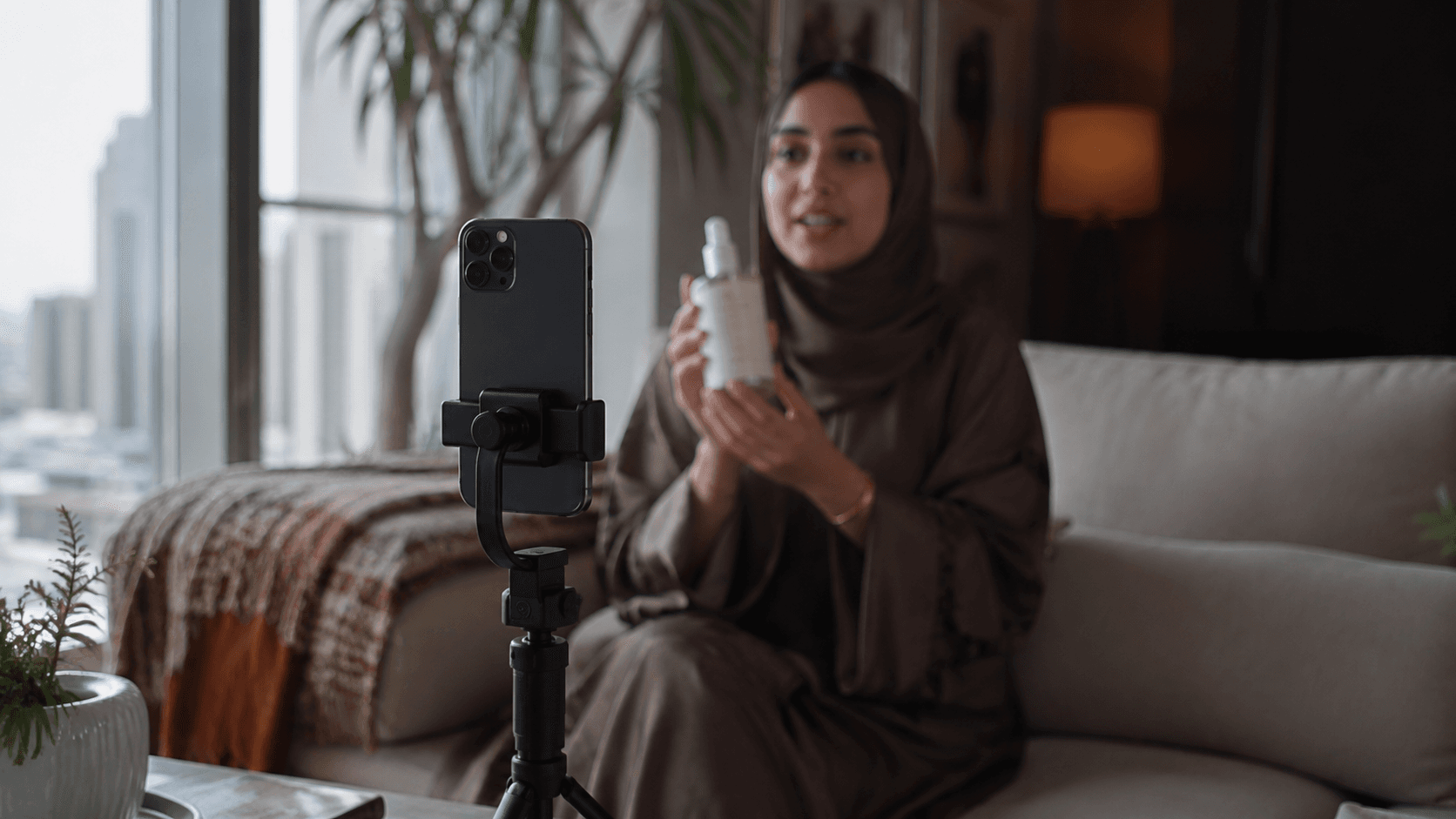
UGC-style ads are the format that currently converts on Snapchat, TikTok and Meta: vertical, hand-held, someone talking straight to camera about a product. AI can now produce that look without booking a creator. What AI cannot do is turn a synthetic person into a customer testimonial — that line is where the legal exposure lives, and it is covered in full below.
What is a UGC ad, exactly?
A UGC ad is a paid ad built to look like organic creator content rather than a produced commercial: vertical framing, hand-held camera, a person speaking directly to the lens, minimal polish. Platforms recommend the style explicitly. Snap tells advertisers to "Think native style," saying ads featuring UGC "can be significantly stronger at driving view-through" (Snapchat for Business). TikTok's help centre tells performance advertisers to use a "DIY or not overly polished style so that it fits in with the user-generated content on TikTok" (TikTok Ads help).
Note what the definition is about: the aesthetic and the delivery, not the provenance. Nothing in either platform's guidance says the person must be an unpaid customer. That distinction becomes legally load-bearing the moment your script starts making claims about experience with the product.
What's the difference between licensed creator content and a brand-produced lookalike?
Licensed creator content is footage a real person shot, which you buy usage rights to. A brand-produced lookalike — whether shot with a hired actor or generated with AI — is your own creative wearing UGC clothing. Contractually they are opposites: one is a licence, the other is authorship.
Marketplaces make the licence explicit. Trend.io states buyers get "Full licensing & distribution rights to your content" for "social, websites, ads, & more," and that "Every piece of content you approve is fully licensed to you" (Trend.io pricing). JoinBrands says "When you purchase any content, you will acquire unlimited usage rights" (JoinBrands pricing). Read those terms before you assume perpetuity — usage windows, paid-media rights and whitelisting are often priced separately.
There is a third path that is neither: boosting the creator's own post. TikTok's Spark Ads let advertisers "use posts from organic TikTok accounts" so views, comments and follows accrue to the organic post, with the creator's "authorization" required and revocable — and a video "needs to be un-authorized as a Spark Ad before it can be deleted from the organic account" (TikTok Ads help). That is a permission structure AI cannot replicate.
Does creator-style creative actually perform better?
Yes, on the platforms' own numbers — and you should read them knowing the platforms sell the format. TikTok internal analysis reports creator ads drive "a 70% higher click-through rate" and "159% higher engagement rate than non-creator ads for the same CPM," attributed to a February 2024 – January 2025 window (TikTok for Business).
Separately, TikTok's Creative Experts Center found ads posted to a creator's own account show a "59% higher engagement rate" and "16% higher six-second view-through rate" than those that are not — a 2024–2025 analysis. That second stat is about distribution, not aesthetics, and AI-generated creative cannot access it.
Meta's own data, reported by eMarketer in December 2025, has partnership ads delivering "19% lower CPAs and 13% higher click-through rates" than standard formats, with testimonial overlays adding "7.5% higher offsite conversions" (eMarketer). Snap's guidance says UGC-style ads "typically get viewed in full compared to more polished ads" (Snapchat for Business).
All four of those data points are vendor-published. Snap, TikTok and Meta each monetise the behaviour they are measuring, none published methodology, and none was independently audited. Treat them as directional evidence that the format works — not as effect sizes you can forecast against.
Whose data is whose? A source-honesty table
Before you cite any of these in a deck, know who paid for them and when.
| Claim | Whose data | Period | Independent? |
|---|---|---|---|
| Creator ads +70% CTR, +159% engagement | TikTok internal analysis | Feb 2024 – Jan 2025 | No — TikTok-published |
| Ads on creator account +59% engagement, +16% 6s VTR | TikTok Creative Experts Center | 2024–2025 | No |
| Partnership ads −19% CPA, +13% CTR | Meta, via eMarketer | Underlying data undated | No — Meta-sourced |
| UGC ads "viewed in full" | Snap creative guidance | Undated | No |
| "64% of Snapchat Ads are viewed with noise on" | Snap | Q1 2019 | No — and seven years old |
| LLM ads beat human ads 59.1% on psych principles | arXiv preprint (n=400, n=800) | Submitted Dec 2025 | Academic, preprint — not peer-reviewed |
The sound stat deserves a flag of its own. Snap attributes "64% of Snapchat Ads are viewed with noise on" to Q1 2019 data, while its app-install guidance says "Two-thirds of Snaps are played with sound on" (Snap app creative guidance). Those are consistent with each other but both are old. The safe operating conclusion — build for sound-on, caption anyway — survives either number.
What are the craft rules the platforms actually publish?
Four rules, all from platform documentation, cover most of the gap between an AI UGC ad that works and one that gets scrolled.
Front-load in 3 seconds, hook by 6. TikTok: "Introduce your content proposition in the first 3 seconds for better recall and awareness" and "Prioritize your hook in the first 6 seconds to boost engagement" (TikTok Ads help). TikTok also reports "90% of ad recall impact is captured within the first six seconds," from studies conducted 2020–2022 (TikTok for Business).
Text at 5-10 words per second. Same TikTok guidance, which also recommends 3-5 creatives per ad group — a volume target AI generation is unusually well suited to hitting.
Go short. Snap's guidance: "Find your timing sweet spot. Ads between 3-5 seconds often drive action," with the offer message landing "between seconds 2 and 3," and brand moments before the :02 mark — while warning against opening on a static logo frame (Snapchat for Business).
Build for sound. Snap's own numbers above put Snapchat ad viewing majority sound-on, which is the opposite of the muted-feed assumption most brand teams carry over from Facebook.
What does human UGC cost versus AI UGC?
Published marketplace rates put licensed human UGC in the $25–$92 per video band depending on volume tier. Trend.io lists Starter at $550 for up to 6 videos (about $91.67 each) down to Scale at $3,872 for up to 56 videos (about $69.14 each), with credits expiring 12 months after purchase (Trend.io). JoinBrands lists "UGC Videos $25+" per video with platform fees of 15% down to 8% by tier (JoinBrands).
Managed human production sits an order of magnitude higher. Icon lists its main plan at "$999 / mo" for "6 Human UGC ads (100% real / no AI): 2 creators × 3 ads each" with unlimited revisions and asset ownership (icon.com) — roughly $167 per finished ad, with a human account team attached. Traditional Saudi video production is higher again: one Saudi agency quotes social media ads at SAR 10,000–25,000 for a set of three (Black Swan Media), and another quotes SAR 5,000 for a basic monthly content shoot up to SAR 25,000+ for a multi-platform package (247 Agency, June 2026). Both are aggregator quotes without disclosed methodology.
AI generation is priced per subscription rather than per asset, which is why the comparison below is about fit, not just cost.
| Hire a UGC creator | Generate AI UGC | |
|---|---|---|
| Cost | $25–$92/video on marketplaces (Trend.io, JoinBrands); ~$999/mo for 6 managed ads (Icon); SAR 10,000–25,000 per set of 3 for agency production in KSA (Black Swan Media) | Subscription-priced, not per-asset — POPCORN starts at $11.99/month billed annually |
| Turnaround | Days to weeks — briefing, shipping product, shooting, revisions | Minutes to hours per variant |
| Volume | Limited by creator availability and budget per shoot | Effectively limited by budget tier, not scheduling |
| Real product in real hands | Yes — genuine unboxing, texture, use | No — product presence must be supplied as reference imagery |
| Can it be a testimonial? | Yes, if the creator genuinely used the product and the connection is disclosed | No. A synthetic person has no experience to report |
| Can it run as a Spark Ad / partnership ad? | Yes — creator-account posting is available | No — there is no creator account behind it |
| Language and dialect | Constrained to the creators you can find and book | Script-level control over language and regional accent |
| Best when | You need credible lived experience, social proof, or creator-account distribution | You need volume for testing, tight iteration on hooks, or dialect coverage no local roster gives you |
The honest read: creator content and AI UGC are not substitutes at the top of the funnel where trust matters, and are close substitutes in the middle of a testing programme where you need thirty hook variants by Thursday. Most disciplined teams run both — AI to find the winning hook cheaply, a human creator to shoot the version that carries the testimonial claim.
How do I actually make one? A working sequence
Six steps, all of which map to rules published above.
- Pick one claim. One benefit, stated once. Not a feature list. Snap's "What to Avoid" list explicitly names overloading the ad with images, stickers and multiple CTAs (Snapchat for Business).
- Write the hook first, in the buyer's actual dialect. The first three seconds carry the ad. Write them before anything else, then write backwards.
- Generate the presenter and the read. Give the system the product images — a physical product ad without its own product imagery will look generic no matter how good the actor is.
- Cut to spec. Vertical 9:16, 1080 × 1920px, .mp4 or .mov, H.264 for Snapchat (Snapchat top snap specs). Keep the top 150px and bottom 330px clear of graphics and logos so Snap's ad UI doesn't cover them.
- Caption at 5-10 words per second, and make sure the audio actually works — Snap specifies a −16 LUFS target and balanced two-channel audio.
- Ship 3-5 variants per ad group, per TikTok's guidance, and let the auction sort them.
If you want the platform-specific version of steps 4–6, the Arabic Snapchat ad guide covers specs and setup end to end, and the Saudi Snapchat cost guide covers what you should expect to pay for the media behind the creative.
What are the disclosure rules for AI UGC ads?
This is the section that decides whether your programme is a smart cost lever or a liability. Two separate regimes apply: US consumer-protection law on fake testimonials, and platform AI-labelling policy.
The FTC rule is not ambiguous. 16 CFR § 465.2 makes it an unfair or deceptive practice "for a business to write, create, or sell a consumer review...that materially misrepresents...That the reviewer or testimonialist exists" (Cornell LII). Businesses also may not disseminate a testimonial they "knew or should have known" materially misrepresented that the testimonialist exists. The rule took effect 21 October 2024, and the Commission's preamble states plainly that "AI-generated reviews are covered by the final rule," noting AI lets actors "generate, quickly and cheaply, large numbers of realistic but fake reviews" (Federal Register, 22 Aug 2024).
And the endorsement definition is broad. 16 CFR § 255.0 defines an endorsement as "any advertising, marketing, or promotional message for a product that consumers are likely to believe reflects the opinions, beliefs, findings, or experiences of a party other than the sponsoring advertiser," with the endorser being a party that "could be or appear to be an individual, group, or institution" (Cornell LII). Example 10 already required clear disclosure when actors represent themselves as actual consumers — that logic predates AI and applies to it directly.
Put together: an AI actor reading a script is a spokesperson, not a customer. "I've been using this for three months and my skin cleared up" spoken by a person who does not exist is a fabricated testimonial. "Here's what this does" spoken by an obvious brand presenter is an ad. Write the second one.
What are the platform AI-labelling policies?
Three of the big platforms label AI content, and the rules differ enough that you need to know each.
Meta labels ads created or "significantly edited" using its generative AI creative tools. Labels sit behind the three-dot menu for most AI-edited ads, and appear "next to the Sponsored label" when AI generates photorealistic humans; minor edits like resizing and colour correction don't trigger a label (Meta Newsroom, 3 Feb 2025). Significant edits explicitly include "background generation and image generation," and for social-issue, election or political ads the advertiser must self-disclose AI-created or AI-edited media (Meta help).
TikTok requires creators to label AI-generated content containing "realistic images, audio or video," introduced an AIGC label for content "completely generated or significantly edited by AI," and has tested automatic detection (TikTok Newsroom, Sep 2023). Content made in TikTok's own Symphony suite "is automatically labeled as AI-generated" (TikTok Newsroom, Jun 2025).
YouTube requires disclosure of realistic altered or synthetic content — making a real person appear to say something they didn't, altering footage of a real event, or generating a realistic scene that didn't occur. Beauty filters, colour adjustment, scripts and thumbnails do not require disclosure. Repeated failure can lead to content removal or monetization suspension (YouTube Help).
The practical rule: if your AI presenter is photorealistic, assume the ad gets labelled, and design the creative so the label costs you nothing. An ad that only works if the viewer thinks the person is real is an ad with a structural problem.
Does the audience punish AI ads?
The one non-vendor data point available suggests less than you'd expect, with a large caveat. An arXiv preprint covering two studies (n=400 and n=800) found LLM-generated ads reached "statistical parity with human-written ads (51.1% vs. 48.9%, p > 0.05)" on personality-targeted personalization, and when built on psychological principles, "AI-generated ads significantly outperformed human-created content, achieving a 59.1% preference rate (vs. 40.9%, p < 0.001)" — strongest on authority (63.0%) and consensus (62.5%) appeals (arXiv, Dec 2025).
Most usefully: nearly 30% of participants chose the AI ad even after identifying it as AI. That undercuts the assumption that disclosure kills performance.
Two caveats before you build a strategy on this. It is a preprint, not peer-reviewed. And it measures stated ad preference in a study setting, not purchase behaviour in a live auction. It is a reason to test disclosure rather than fear it — not proof that labelling is free.
Where does dialect fit in?
For Arabic-speaking markets, this is where AI UGC has a genuine structural advantage over the human roster available to most brands. Booking a Saudi creator, a Kuwaiti creator and an Egyptian creator for the same script triples your cost and your scheduling problem. Generating the same script in three accents does not.
There is demand-side evidence that it matters: research based on 400 Saudi consumers aged 16–44, published June 2026, found more than 30% of Saudi consumers believe advertising from local brands lacks cultural relevance (Campaign Middle East). The same report notes digital ad spend in Saudi Arabia grew 23.5% year-on-year in 2024 — the fastest rate in MENA — while e-commerce growth lagged that investment by 8 percentage points.
Beware the dialect-count marketing on tooling. "160+ languages" typically means locale coverage in a dropdown, not a native-sounding Gulf read. And one published lip-sync comparison notes that "Arabic and Hebrew include pharyngeal sounds that require throat and tongue movements not present in English-trained models" (khaby.ai, updated March 2026) — a secondary source with undisclosed methodology, but a real technical constraint. Judge the output, not the feature list. POPCORN was built Arabic-first for exactly this reason; the AI video ad generator comparison covers how the alternatives handle it.
What's a sane first test?
Six ads, one product, one claim, three hooks, two presenters. Keep every ad between 3 and 10 seconds. Caption everything. Label the AI. Do not put a testimonial claim in any of the scripts — save that for a human creator once you know which hook wins.
Then measure at the hook level, not the ad level. The value of AI UGC is not that any single ad is better; it is that you can afford to find out which hook works before you spend money on the version a real person delivers.
Frequently asked questions
Do I have to tell viewers my ad uses an AI actor?
On the major platforms, effectively yes for photorealistic humans. Meta labels ads created or significantly edited with its generative AI tools, placing the label next to the Sponsored label when AI generates photorealistic humans (Meta Newsroom, Feb 2025). TikTok requires labelling of AI-generated realistic images, audio or video. YouTube requires disclosure of realistic synthetic content. Separately from platform policy, US law bars presenting a non-existent person as a testimonialist under 16 CFR 465.2.
Can an AI presenter say "I've been using this for months"?
No. 16 CFR 465.2 makes it deceptive to disseminate a testimonial that materially misrepresents that the testimonialist exists, and the FTC's preamble to the rule (effective 21 October 2024) states AI-generated reviews are covered. A synthetic person has no product experience to report. Write the presenter as an obvious brand spokesperson describing the product, not as a customer recounting results.
How long should a UGC-style ad be?
Short. Snap's creative guidance says ads between 3-5 seconds often drive action, with the offer message landing between seconds 2 and 3, and its Sponsored Snaps guidance recommends keeping under 10 seconds. TikTok says to introduce your proposition in the first 3 seconds and prioritize the hook in the first 6. Snapchat's technical minimum is 3 seconds; anything shorter is looped.
Is AI UGC cheaper than hiring a creator?
Per asset, usually — but the comparison is not like-for-like. Published marketplace rates run about $25 to $92 per licensed human video (JoinBrands, Trend.io), and managed human UGC around $999/month for six ads (Icon). AI tools are subscription-priced rather than per-asset, so the saving grows with volume. What you lose is real product-in-hand footage, genuine testimonial rights, and access to creator-account posting formats like Spark Ads.
Can I run AI-generated UGC as a TikTok Spark Ad?
No. Spark Ads work by boosting an existing post from an organic TikTok account, with that account holder's authorization, so engagement accrues to the organic post. There is no organic creator account behind AI-generated footage. TikTok's own analysis found ads posted to a creator's account get 59% higher engagement and 16% higher six-second view-through — a lift AI creative structurally cannot access.
How much of the performance data on UGC ads is independent?
Very little. The headline figures on creator-ad performance come from TikTok internal analysis, Meta's own data, and Snap's creative guidance — all published by companies that sell the format, none with disclosed methodology or independent audit. The clearest non-vendor evidence is an academic preprint (arXiv, December 2025) finding AI-generated ads reached parity with human-written ads and beat them when built on psychological principles — itself not peer-reviewed.
Sources
Every figure in this article links to its source. We check them when we update the piece.
TikTok internal analysis: creator ads drive a 70% higher click-through rate and 159% higher engagement rate than non-creator ads for the same CPM (Feb 2024 – Jan 2025)
ads.tiktok.com(opens in a new tab)TikTok guidance: introduce proposition in first 3 seconds, prioritize hook in first 6 seconds, text overlays at 5-10 words per second, 3-5 creatives per ad group, use a DIY or not overly polished style
ads.tiktok.com(opens in a new tab)TikTok: 90% of ad recall impact is captured within the first six seconds (studies conducted 2020–2022)
ads.tiktok.com(opens in a new tab)Snap: UGC-style ads typically get viewed in full compared to more polished ads; 64% of Snapchat Ads are viewed with noise on (Q1 2019)
forbusiness.snapchat.com(opens in a new tab)Snap creative guidance: think native style, ads between 3-5 seconds often drive action, offer message between seconds 2 and 3, keep top 150px and bottom 330px clear, What to Avoid list
businesshelp.snapchat.com(opens in a new tab)Snapchat top snap specs: 1080x1920px 9:16, .mp4/.mov H.264, 3 seconds to 30 minutes, audio target -16 LUFS with two balanced channels
businesshelp.snapchat.com(opens in a new tab)Snap app-install guidance: two-thirds of Snaps are played with sound on; recommended video length 3-5 seconds
forbusiness.snapchat.com(opens in a new tab)Snap ad-spec guidance for Sponsored Snaps: recommend keeping under 10 seconds
forbusiness.snapchat.com(opens in a new tab)Meta's own data: partnership ads deliver 19% lower CPAs and 13% higher click-through rates; testimonial overlays yield 7.5% higher offsite conversions
emarketer.com(opens in a new tab)Meta labels ads created or significantly edited with its generative AI tools; label appears next to the Sponsored label when AI generates photorealistic humans
about.fb.com(opens in a new tab)Meta AI info label triggers on significant edits including background and image generation; advertisers must self-disclose AI media in social issue, election and political ads
meta.com(opens in a new tab)TikTok requires creators to label AI-generated content containing realistic images, audio or video
newsroom.tiktok.com(opens in a new tab)TikTok Symphony content is automatically labeled as AI-generated
newsroom.tiktok.com(opens in a new tab)YouTube requires disclosure of realistic altered or synthetic content; beauty filters and colour adjustment do not require disclosure; repeated failure can lead to removal or monetization suspension
support.google.com(opens in a new tab)16 CFR 465.2: deceptive for a business to create a review or testimonial that materially misrepresents that the testimonialist exists
law.cornell.edu(opens in a new tab)FTC Rule on Consumer Reviews and Testimonials effective 21 October 2024; preamble states AI-generated reviews are covered by the final rule
govinfo.gov(opens in a new tab)16 CFR 255.0 defines an endorsement and requires disclosure when actors represent themselves as actual consumers (Example 10)
law.cornell.edu(opens in a new tab)Trend.io UGC pricing: $550 for up to 6 videos to $3,872 for up to 56 videos; full licensing and distribution rights; credits expire after 12 months
trend.io(opens in a new tab)JoinBrands lists UGC Videos at $25+ per video with unlimited usage rights and platform fees of 15% down to 8%
joinbrands.com(opens in a new tab)Icon lists its main plan at $999/mo for 6 human UGC ads (2 creators x 3 ads each) with unlimited revisions and full asset ownership
icon.com(opens in a new tab)TikTok Spark Ads require creator authorization, attribute engagement to the organic post, and videos must be un-authorized before deletion
ads.tiktok.com(opens in a new tab)Saudi video production pricing: Social Media Ads (set of 3) SAR 10,000–25,000
blackswanmedia.me(opens in a new tab)Saudi social content production quoted at SAR 5,000 for a basic monthly shoot up to SAR 25,000+ for a multi-platform package
247agency.ae(opens in a new tab)More than 30% of Saudi consumers believe local brand advertising lacks cultural relevance; Saudi digital ad spend grew 23.5% YoY in 2024, with e-commerce lagging by 8 percentage points
campaignme.com(opens in a new tab)Arabic and Hebrew include pharyngeal sounds requiring movements not present in English-trained lip-sync models
khaby.ai(opens in a new tab)arXiv preprint: LLM-generated ads reached parity with human-written ads (51.1% vs 48.9%), and 59.1% preference when built on psychological principles; nearly 30% chose the AI ad after identifying it as AI
arxiv.org(opens in a new tab)
Drafted with AI assistance. Written, fact-checked and published by a human editor.
Mohamed Hedar
Co-founder of POPCORN, an AI video-ad studio built Arabic-first for Saudi and the Gulf. Writes about what actually performs in Saudi social advertising — from Snapchat creative specs to what a video ad really costs to make.
Make the ad instead of reading about it
POPCORN turns a product link into a finished video ad — with your character, your language, your platform.